If you’re looking for the best off-road electric bike, you need more than just a powerful motor.
A good off-road e-bike should also have strong brakes, dependable suspension, enough battery for longer rides, and tires that can handle dirt, gravel, sand, and rough trails.
We have tested and reviewed the top off-road e-bikes in 2026 so you can pick the right one with confidence.
Some of the links on this site are affiliate links. This means we may earn a commission if you make a purchase through them, at no extra cost to you.
Top Off-Road E-Bikes At a Glance
Here’s a quick side-by-side comparison of the top models before we dive into the detailed reviews:
| Bike | Best For | Motor | Battery | Tires | Suspension | Top Speed |
|---|---|---|---|---|---|---|
| PUCKIPUPPY Labrador Pro | Best overall | 1350W peak | 48V 20Ah | 26×4.0 fat | Full | 28 mph |
| Qlife Spark | Best budget | 1500W peak | 48V 13Ah | 20×4.0 fat | Dual | 28–35 mph |
| Windone E2/K20 | Best retro style | 750W (1000W peak) | 48V 13–15Ah | 20–26×4.0 | Front | 28 mph |
| PHNHOLUN Adria26 | Best torque | Dual, 210 Nm | 52V 25Ah | 26×4.0 fat | Full | — |
| Ridstar Q20 | Best value | 1000–2000W | 48–52V, 20–40Ah | 20×4.0 fat | Dual | Up to 30 mph |
| LEONX M2 Pro | Best long-range | 1800W peak | 48V 17.5Ah | 26×4.0 fat | Full | 36 mph |
| EcoE 5000W Dual Motor | Best extreme power | Dual 2500W | 60V 32Ah | 26×4.0 fat | Full | 52+ mph |
| TUTTIO ICT 4000W | Teens & young riders | 2000W (4000W peak) | 60V 25Ah | 20×4.0 fat | Full | 43 mph |
| PUJH 29-inch | Best 29er trail | 1500W peak | 48V 17.5Ah | 29×2.1 MTB | Front | 28–32 mph |
| LPQVIATAS 5000W | Best AWD | Dual 2500W | 52V 34Ah | 24×4.0 fat | Full | Up to 46 mph |
| Seemoon Dual Motor 3000W | Best suspension | Dual, 3000W peak | 52V 20Ah | 26×4.0 fat | 7-level system | 32–36 mph |
| PUCKIPUPPY Boxer | Flagship design | 960W peak | 48V 20Ah | 26×4.0 fat | Hidden system | 28 mph |
| Qlife Racer | Lightweight budget | 1200W peak | 48V 10.4Ah | 20×4.0 fat | Front | 28 mph |
*Note: High-speed models may be restricted on public roads and trails. Always check local laws and ride with protective gear.
Best Off-Road Electric Bike in 2026: Our Top Picks
- Best Overall: PUCKIPUPPY Labrador Pro
- Best Budget: Qlife Spark Moped-Style E-Bike
- Best Retro Style: Windone E2/K20
- Best Torque: PHNHOLUN Adria26 (Tuttio)
- Best Value Package: Ridstar Q20 Series
- Best Long-Range Mountain Ride: LEONX M2 Pro
- Best for Extreme Power: EcoE 5000W Dual Motor E-Bike
- Best for Teens & Young Riders: TUTTIO ICT 4000W
- Best 29er Trail Option: PUJH 29-Inch 1500W
- Best AWD Option: LPQVIATAS 5000W Dual Motor
- Best Suspension Setup: Seemoon Dual Motor 3000W
- Best Flagship Design: PUCKIPUPPY Boxer
- Best Lightweight Budget Option: Qlife Racer
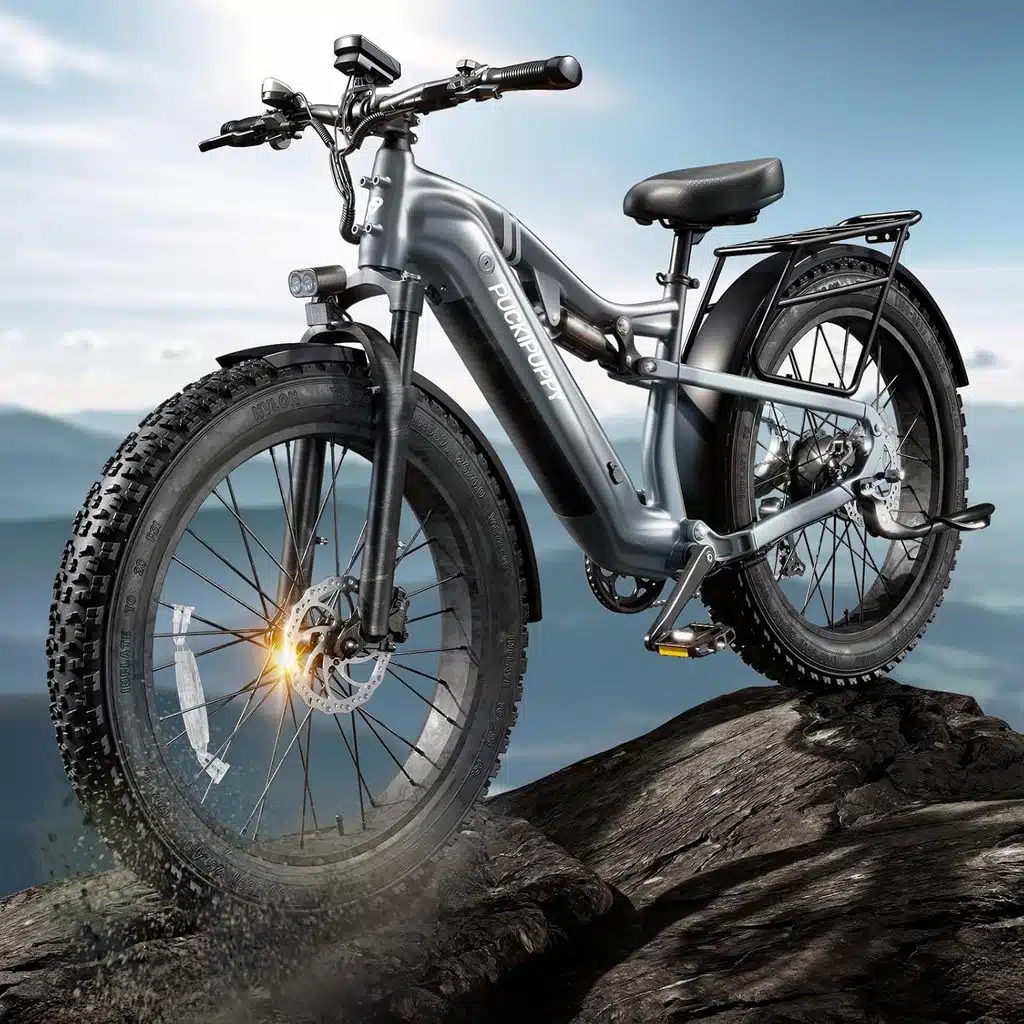
1. Best Overall: PUCKIPUPPY Labrador Pro
Key Details:
- 750W motor, 1350W peak power
- 48V 20Ah removable battery
- 26×4.0 fat tires with full suspension
- Torque and cadence sensor
- 180mm hydraulic disc brakes
- Up to 80 miles claimed range
- Top speed: 28 mph
The PUCKIPUPPY Labrador Pro is our best overall off-road electric bike because it gets the important things right without chasing extreme speed. You get plenty of climbing power, fat tires, suspension, hydraulic brakes, and a torque sensor that makes pedal assist feel much more controlled on uneven ground.
That balance stood out to us. The 1350W peak motor gives it enough punch for hills and loose terrain, while the torque sensor responds to how hard you pedal instead of simply switching the motor on at a fixed level. For trail riding, that smoother power delivery can make the bike easier to manage when traction changes suddenly.
It is also better equipped than many bikes in this category. PUCKIPUPPY rates the removable 48V 20Ah battery for 40 to 80 miles, lists a 400 lb maximum load, and uses 180mm hydraulic disc brakes. The Labrador Pro is also listed as UL 2271 and UL 2849 certified by SGS.
You do give up some outright speed. The 28 mph assisted limit cannot compete with the 40 to 50 mph dual-motor bikes farther down our list. But that is part of why we prefer it as the best choice for most riders. It gives you serious off-road hardware without turning every trail ride into a wrestling match with a 5000W machine.
Pros:
- Smooth torque-sensor pedal assist
- Strong 1350W peak motor
- 48V 20Ah battery with up to 80 miles claimed range
- Hydraulic disc brakes
- Fat tires and full suspension suit mixed terrain
- UL 2271 and UL 2849 certified
Cons:
- 28 mph may feel slow beside dual-motor models
- At 85.7 lbs, it is still a heavy bike
2. Best Budget: Qlife Spark Moped-Style E-Bike
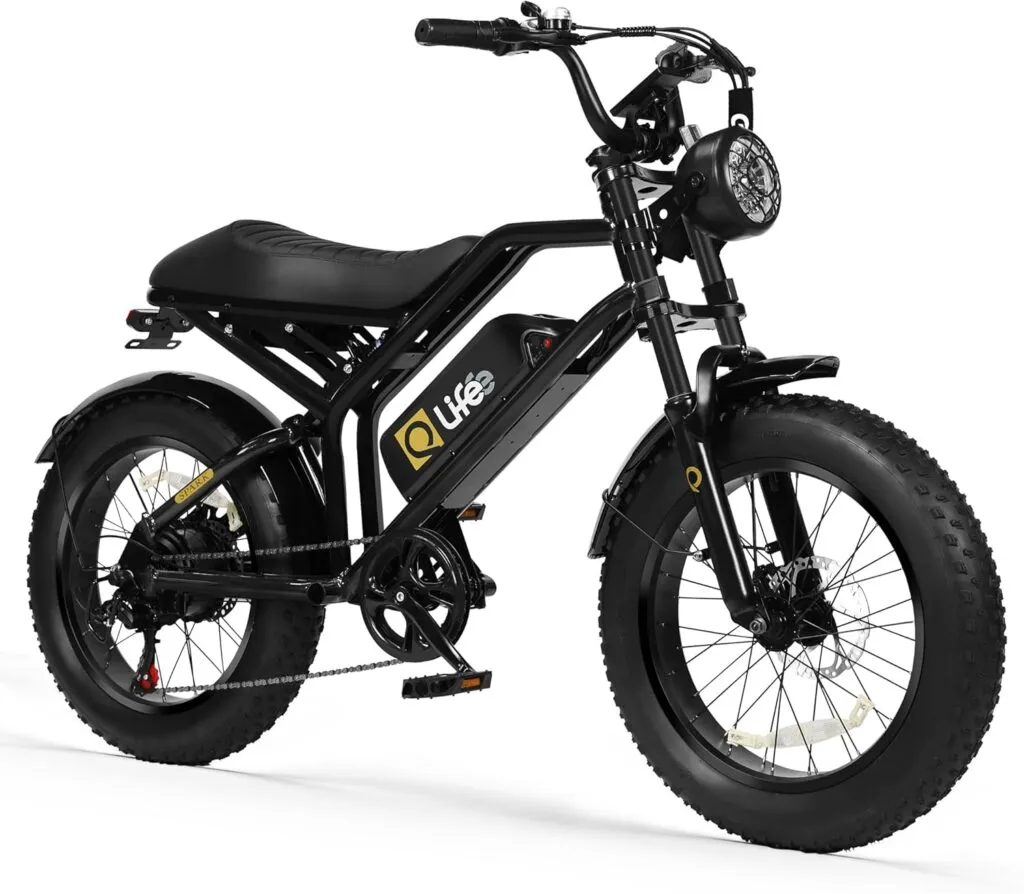
Key Details:
- 1500W peak motor, 48V 13Ah battery
- 20×4.0 fat tires, dual suspension
- LCD center display
- 28 mph stock, unlocks to ~35 mph
The Qlife Spark is a reminder that you don’t need to spend four figures to get a fun, capable ride. When we were testing it, the bike felt playful, snappy off the line, and comfortable enough for daily use.
The moped-style frame adds comfort with a relaxed riding position, making it feel less like a mountain bike and more like a small scooter.
We liked how the Spark handled both pavement and light dirt. The fat tires keep it stable, and the dual suspension soaked up potholes in city riding.
The LCD display is clear and easy to use, showing speed, battery, and assist levels. For a budget pick, those little touches are a big plus.
Of course, the smaller 13Ah battery means range is limited. If you plan longer weekend rides, you’ll need to recharge often.
And while unlocking the speed to 35 mph is fun, keep in mind that braking and handling aren’t quite as sharp as on premium models.
Pros:
- Affordable price for good performance
- Fun moped-style design
- Unlockable higher speed
- Comfortable ride with fat tires and suspension
Cons:
- Limited battery capacity
- Brakes and handling not as refined as pricier bikes
3. Best Retro Style: Windone E2/K20
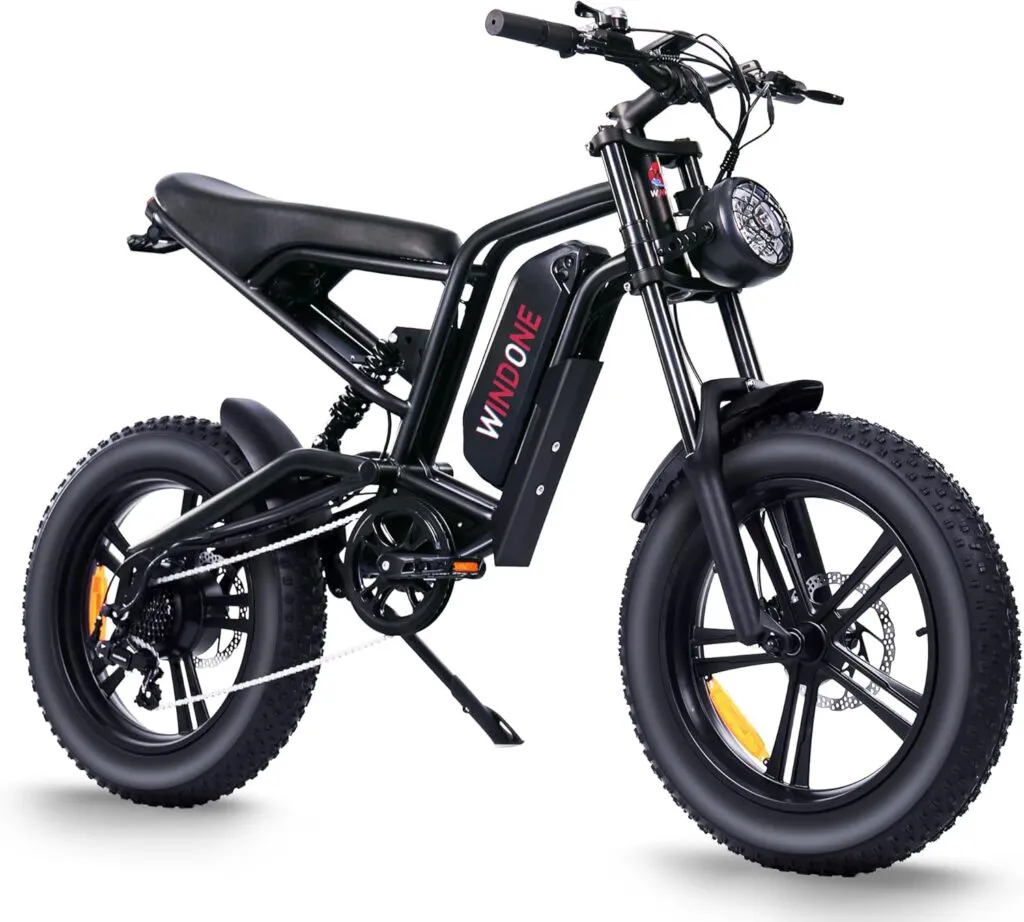
Key Details:
- 750W motor (1000W peak)
- 48V 13–15Ah battery options
- 20×4.0 or 26×4.0 fat tires
- UL2849 certified, IPX5 water resistant
The Windone E2, sometimes called the K20, brings a retro-moto vibe that’s different from most fat-tire bikes. We liked its unique styling during testing, but it’s not just looks; performance is solid.
The 750W motor is Class 3 capable with a 28 mph top assist speed, and the hydraulic brakes inspire confidence when stopping quickly.
This is one of the few bikes in its price range with both UL2849 safety certification and IPX5 water resistance. That means peace of mind if you store it indoors or ride in wet weather.
Range with the 15Ah battery was enough for a full-day city use when we tried it, though heavier riders on throttle only will want to plan for shorter trips.
It’s not as fast or powerful as dual-motor setups, but that’s part of the appeal.
The Windone feels approachable, with a good balance of performance, safety, and design. If you like the retro look, this is a very practical way to stand out.
Pros:
- Retro moto-inspired frame
- Safety-certified battery and electronics
- Comfortable fat tire ride
- Solid stopping power with hydraulic brakes
Cons:
- Not as powerful as bigger dual-motor bikes
- Smaller battery than long-range options
4. Best Torque: PHNHOLUN Adria26 (Tuttio)
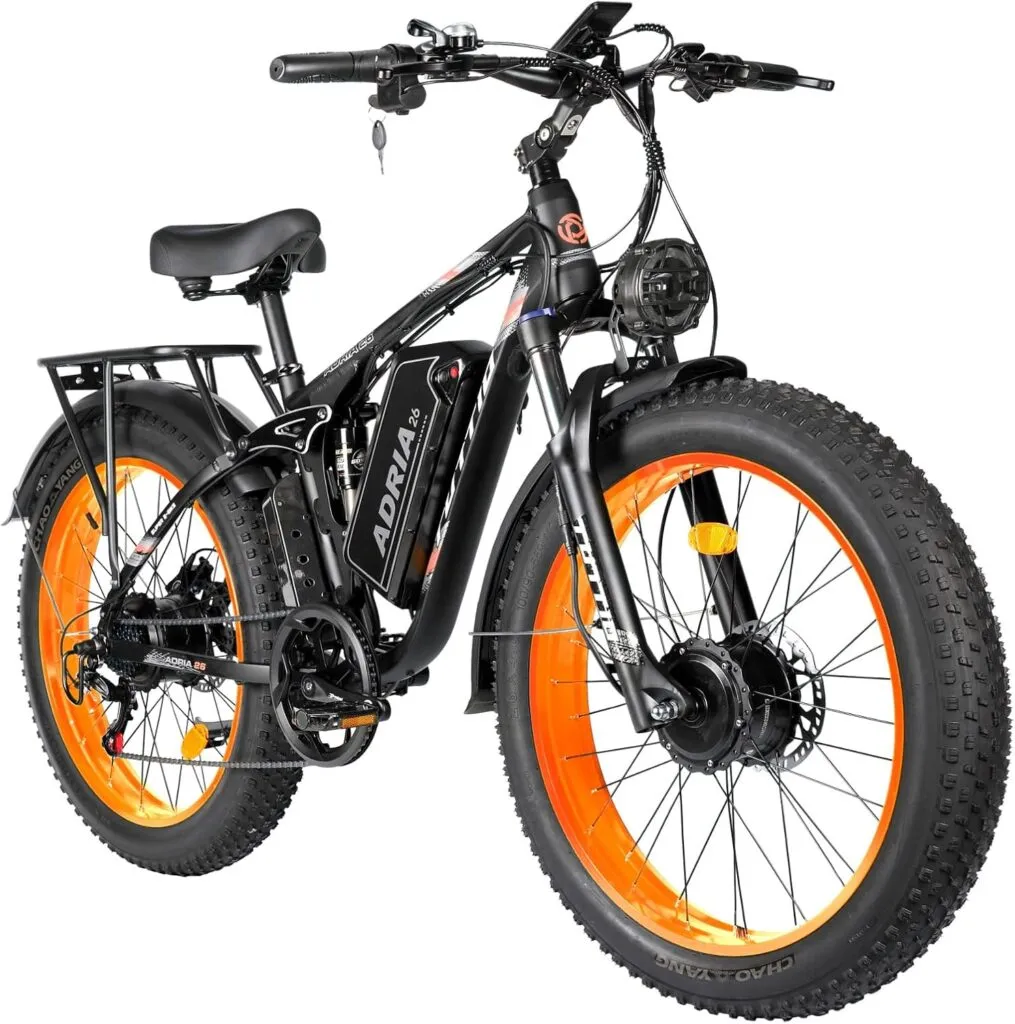
Key Details:
- Dual motors, 210 Nm combined torque
- 52V 25Ah battery
- 26×4.0 fat tires, full suspension
- Hydraulic brakes with heat-resistant controller
The PHNHOLUN Adria26, also sold under the Tuttio name, is built for torque. On steep hill climbs, we felt the difference right away; 210 Nm is more pull than most mid-drive motors offer. It’s a bike made for riders who want brute force in technical terrain.
The 52V 25Ah battery helps back up that torque with long range. We found it easy to ride aggressively for hours without dipping into low battery warnings.
Hydraulic brakes held up on extended downhill runs, and the cooling design in the controller kept performance consistent instead of fading.
That said, it’s a big and aggressive machine. Riders who just want a relaxed commuter will probably find it overbuilt.
And while the torque is great for climbs, it may be more than some new riders are ready for. If you know you want raw pulling power, though, this bike is a beast.
Pros:
- Extremely high torque for steep hills
- Long-lasting 52V 25Ah battery
- Reliable braking even under load
- Comfortable with full suspension
Cons:
- Too aggressive for casual riders
- Heavy and harder to maneuver in tight spaces
5. Best Value Package: Ridstar Q20 Series
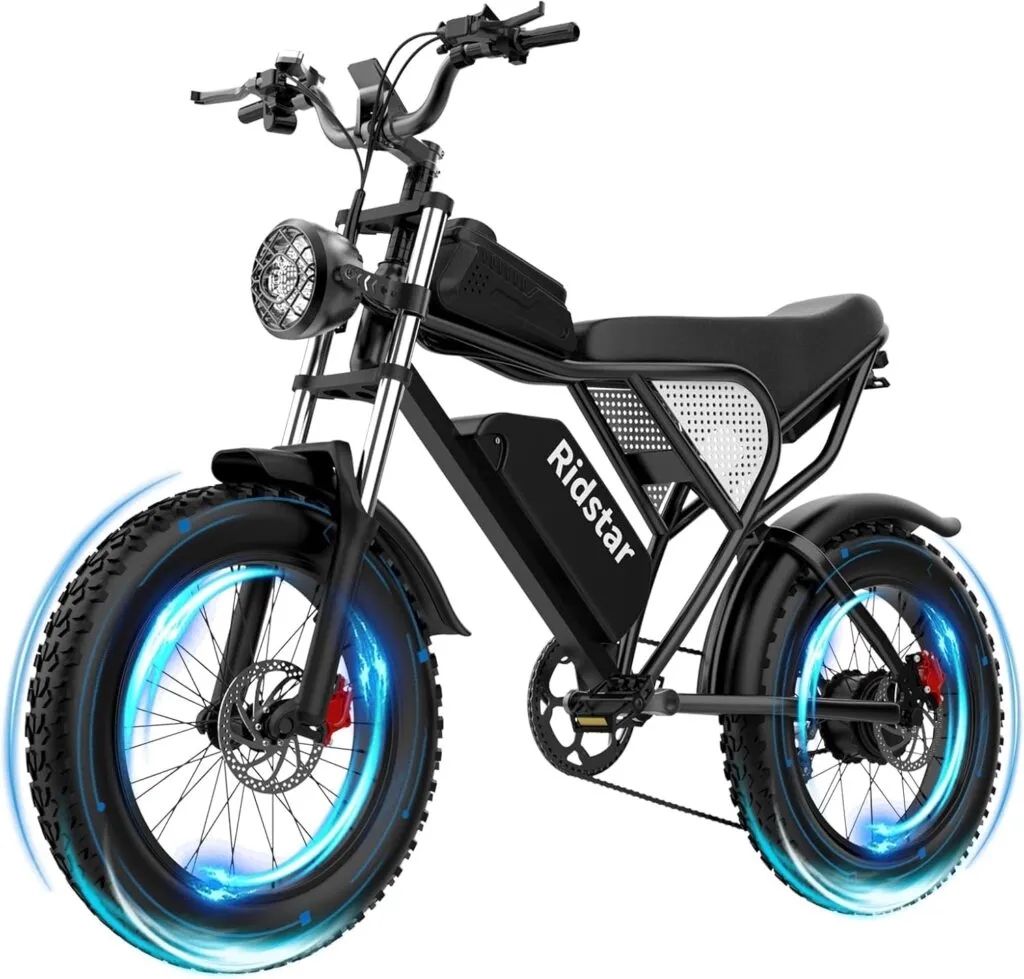
Key Details:
- Motor options: 1000–2000W, 48–52V battery
- 20Ah or 40Ah removable battery choices
- 20×4.0 fat tires with dual suspension
- Top speed: up to 30 mph
The Ridstar Q20 stands out because of the options it gives riders. When we tested it, we liked how customizable it felt. You can go with a 20Ah setup for lighter use or a massive 40Ah pack for extended trips.
The 20-inch fat tires and suspension kept it steady, even on bumpy city streets and gravel roads.
One thing we noticed is that Ridstar packed in extras that usually cost more. The included phone holder, USB port, and storage box made it a practical commuter as well as an off-road toy. It’s one of those bikes that works as well for grocery runs as it does for weekend dirt trails.
The trade-off is that it’s not the most refined in terms of handling. At higher speeds, the smaller 20-inch wheels don’t feel as planted as bigger 26-inch frames.
But for the price and what comes in the box, it’s hard to argue with the value.
Pros:
- Great price-to-performance ratio
- Large battery options for longer rides
- Comes with useful extras (USB, phone mount, storage box)
- Stable fat tires with suspension
Cons:
- Smaller wheels less stable at high speed
- Heavier than it looks with big battery
6. Best for Long-Range Mountain Rides: LEONX M2 Pro
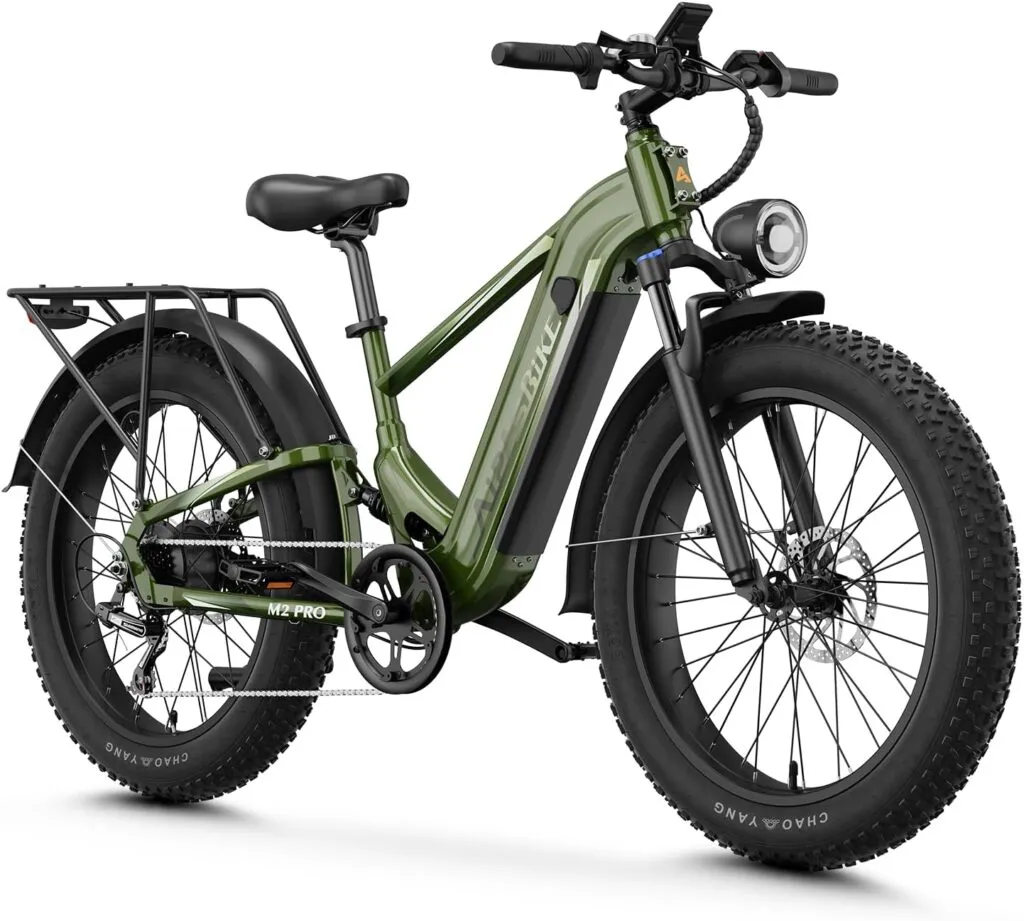
Key Details:
- 1800W peak motor with 110 Nm torque
- 48V 17.5Ah battery (36–85 miles range)
- 26×4.0 fat tires, dual suspension
- Top speed: 36 mph
The LEONX M2 Pro is built for riders who want a true mountain e-bike feel. During testing, we found its 1800W peak motor gave strong hill-climbing ability, and the dual suspension soaked up hits that would normally shake you off the trail.
It felt closer to an e-MTB than a commuter bike, which is exactly what it’s designed for.
The range was impressive for its class. With careful use of pedal assist, we stretched it well past 60 miles in one outing, making it a good fit for all-day adventures.
The hydraulic brakes also gave a lot of control on steep descents, which we appreciated on tricky terrain.
The main drawback is the battery size. At 17.5Ah, it’s not as large as some long-range fat tire bikes, so aggressive throttle use will cut into mileage fast.
But for balanced performance and rugged trail use, the M2 Pro really nails it.
Pros:
- Strong peak motor with great torque
- Full suspension for real trail riding
- Impressive range in PAS mode
- Reliable hydraulic braking system
Cons:
- Smaller battery than other long-range models
- Weighty frame makes it less portable
7. Best for Extreme Power: EcoE 5000W Dual Motor E-Bike
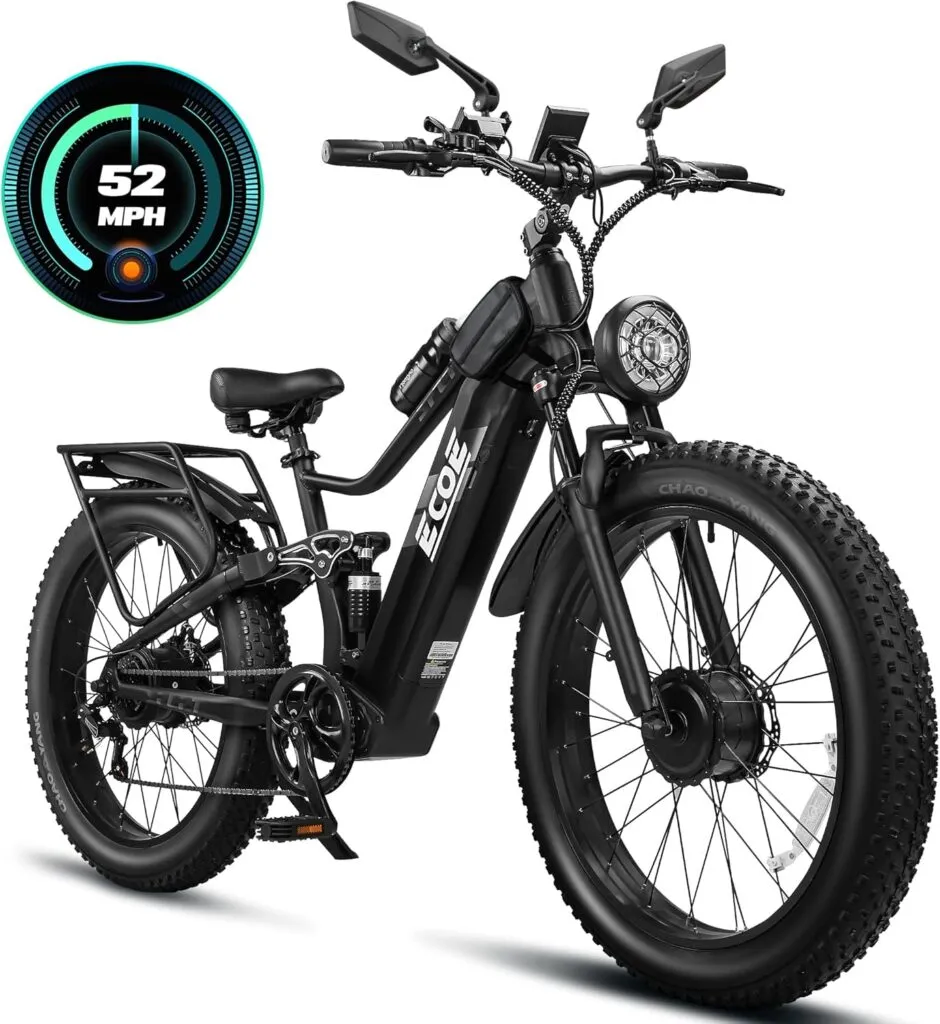
Key Details:
- Dual 2500W motors, 5000W peak output
- 60V 32Ah removable battery
- 26×4.0 fat tires
- Full suspension
- Claimed top speed: 52+ mph
If outright power matters more than anything else, the EcoE 5000W is the bike we would look at. Its dual-motor setup delivers far more output than a normal trail e-bike, with enough pull for steep climbs, loose dirt, sand, and demanding private-land riding.
The 60V 32Ah battery is another big advantage. During aggressive rides, we liked having that extra capacity, particularly when both motors were doing most of the work. Combined with 26×4-inch tires and full suspension, the EcoE feels planted once the terrain gets rough.
There is a catch. A bike this powerful is not the easiest machine to live with. It weighs more than 100 lbs, takes more effort to maneuver at low speed, and its claimed 52+ mph capability puts it well outside normal e-bike rules in many places.
That is why we no longer rank it as the best choice for everyone. For experienced riders who specifically want extreme power on suitable off-road terrain, though, very few bikes in this list offer the same level of performance.
Pros:
- Huge dual-motor output
- Excellent climbing power
- Large 60V 32Ah battery
- Stable 26×4-inch fat tires
- Full suspension for rough ground
Cons:
- Over 100 lbs
- Excessive power for many riders
8. Best for Teens and Young Riders: TUTTIO ICT 4000W
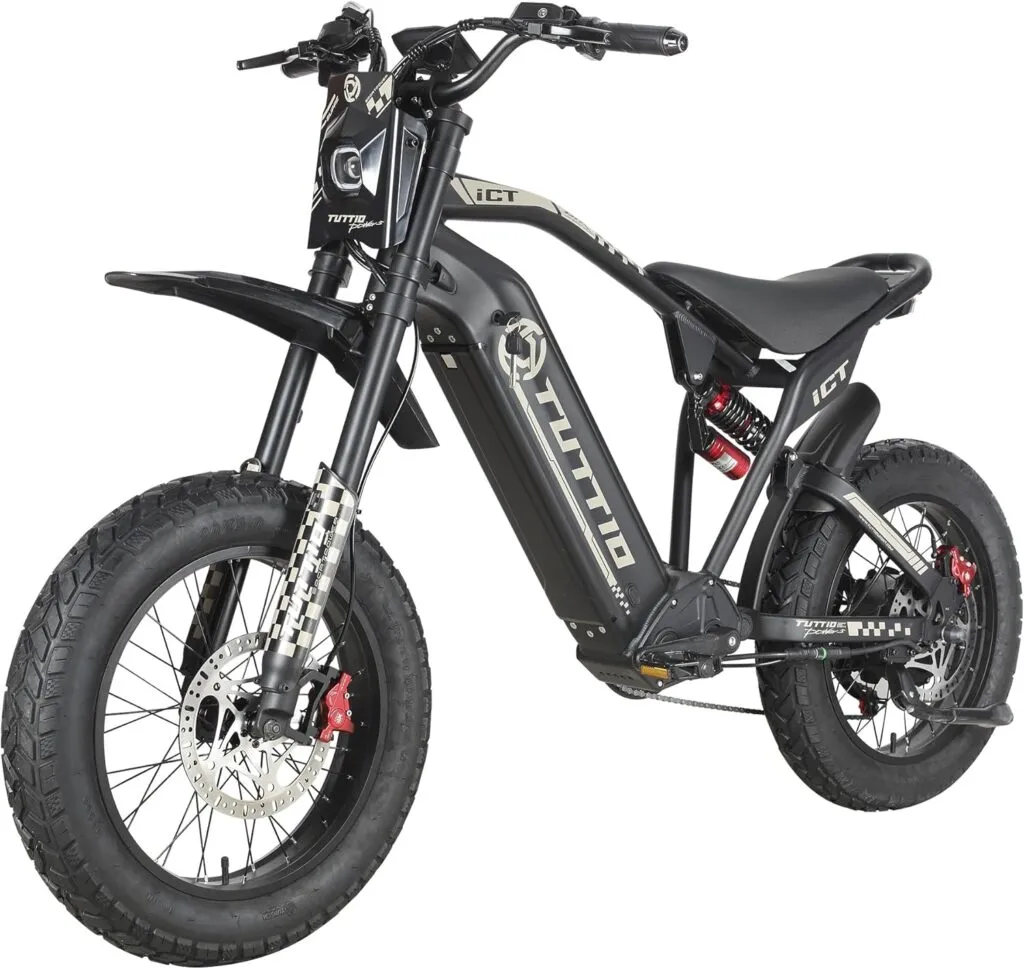
Key Details:
- 2000W motor (4000W peak), 60V 25Ah battery
- 20×4.0 fat tires with full suspension
- Top speed: 43 mph (off-road use only)
- 3 riding modes (electric, PAS, manual)
The TUTTIO ICT feels like an e-dirt bike built for thrill seekers. When we tested it, the power came on fast and strong, making it feel closer to a lightweight motocross bike than a traditional e-bike.
The 20-inch fat tires provided excellent grip on mud and sand, and the bright LED lighting kept it safe for night rides.
This bike shines in shorter, intense rides. The 60V 25Ah battery is capable, but we found real-world range closer to 30–35 miles in throttle mode, which is expected at this power level.
For pedal assist, it stretched to near 70 miles on flat ground, making it versatile for different types of rides.
One important thing to note: at 43 mph, this is not a bike you can take on bike paths or most city streets legally.
It’s marketed for off-road only, so it’s best for riders with private land or trails to explore.
Pros:
- Extremely powerful peak output
- Stable off-road grip from fat tires
- Strong lighting for visibility
- Multiple riding modes
Cons:
- Too powerful for legal road use in most places
- Limited range in throttle-only riding
9. Best 29er Trail Option: PUJH 29-Inch 1500W
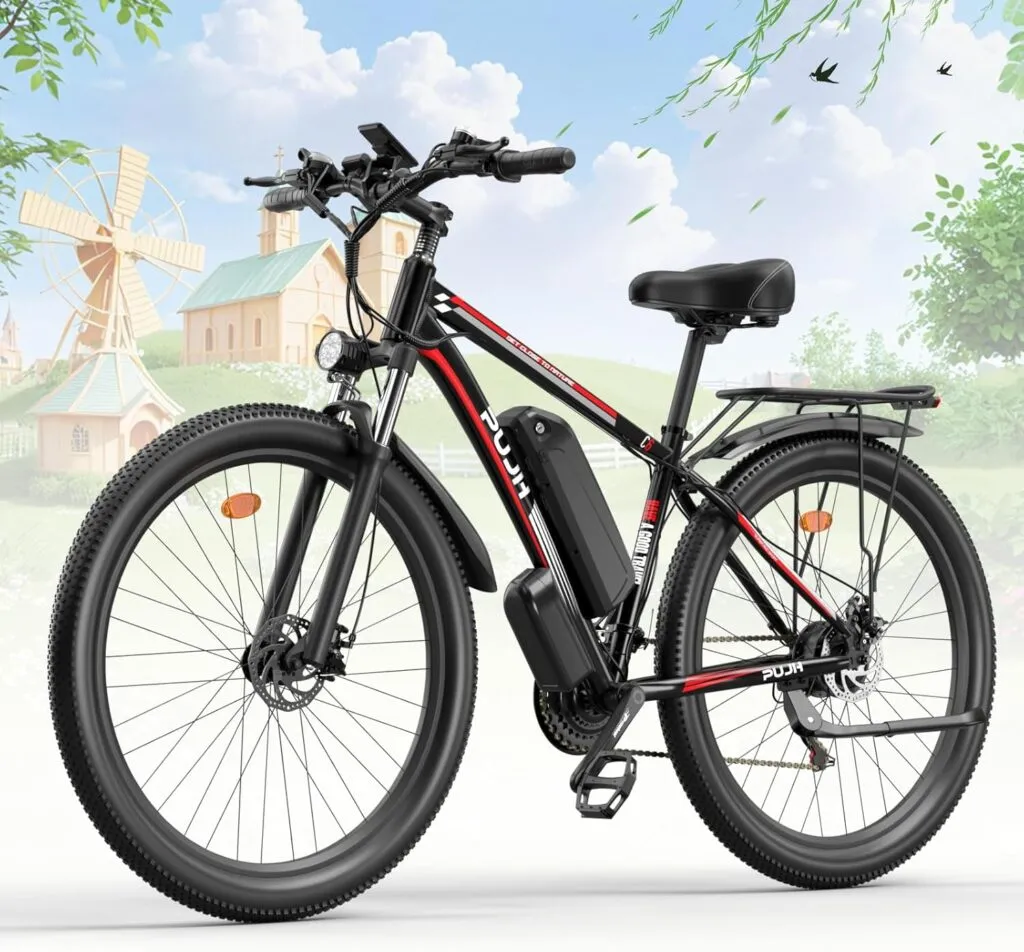
Key Details:
- 1500W peak motor, 60 Nm torque
- 48V 17.5Ah (840Wh) battery
- 29×2.1 MTB tires with front suspension
- Top speed: 28–32 mph
The PUJH 29er brings something different to the table: taller, slimmer tires for trail and commuting use.
We liked how it rolled over roots and potholes better than 20-inch fat-tire bikes. It felt faster on paved paths too, almost like a hybrid between an e-MTB and a Class 3 commuter.
The 21-speed drivetrain gave itthe versatility we don’t always see on fat-tire style bikes. During testing, we found it useful for longer rides where pedaling efficiency mattered.
The included accessories (rack, pump, lock, phone holder) made it ready out of the box for commuting.
It’s not as cushioned as 4-inch fat tires in sand or snow. If you’re buying mainly for soft-surface trails, you’ll miss the float.
But if you like a faster, more traditional MTB feel, this bike nails that balance.
Pros:
- 29-inch wheels roll smoothly over obstacles
- Good commuter and trail hybrid option
- Comes with many useful accessories
- Top speed up to 32 mph
Cons:
- Less float on sand or snow
- Smaller battery compared to ultra-long-range bikes
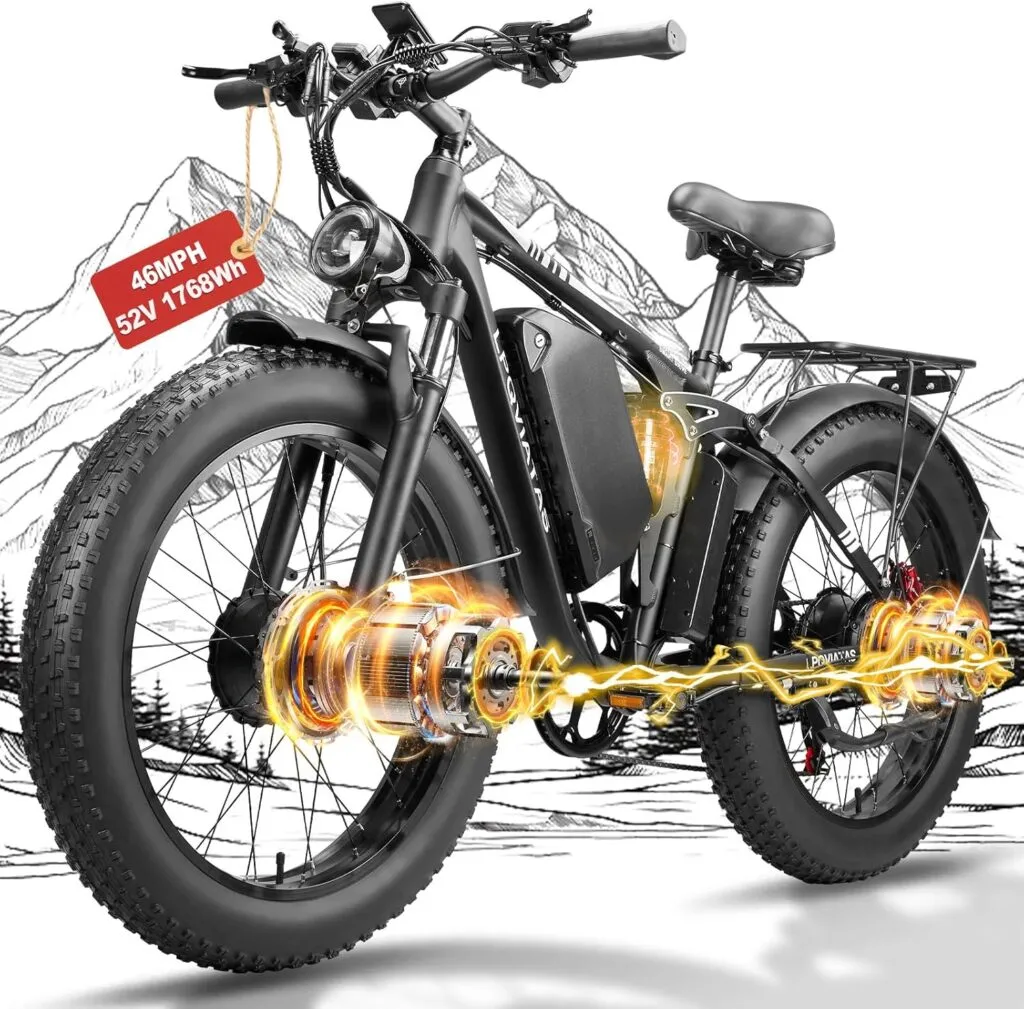
10. Best AWD Option: LPQVIATAS 5000W Dual Motor Off Road E-Bike
Key Details:
- Dual 2500W motors (5000W peak, 220 Nm torque)
- 52V 34Ah battery (1768Wh)
- 24×4.0 fat tires with full suspension
- Top speed: up to 46 mph
The LPQVIATAS AWD is for riders who want an extreme off-road electric bike with both speed and stamina.
When we tested it, the dual motors pulled hard even up steep, loose climbs that would stall a single-motor bike. The AWD setup gave extra traction in sand and snow, making it feel unstoppable.
We liked the huge 52V 34Ah battery, which lasted noticeably longer than most competitors. In pedal assist mode, we managed nearly 90 miles on a single charge, which is rare in this category.
The hydraulic disc brakes felt equally up to the task, stopping quickly even after repeated downhill runs.
It’s worth noting, though, this e-bike is heavy and very fast. It’s really best for experienced riders who know how to handle a machine closer to a dirt bike than a commuter.
Not every trail system will allow it, so check local rules before riding.
Pros:
- AWD dual motor system with massive torque
- Long-range 52V 34Ah battery
- Fat tires and suspension excel off-road
- Hydraulic brakes give strong stopping power
Cons:
- Very heavy and bulky
- Too fast for many public trails or bike paths
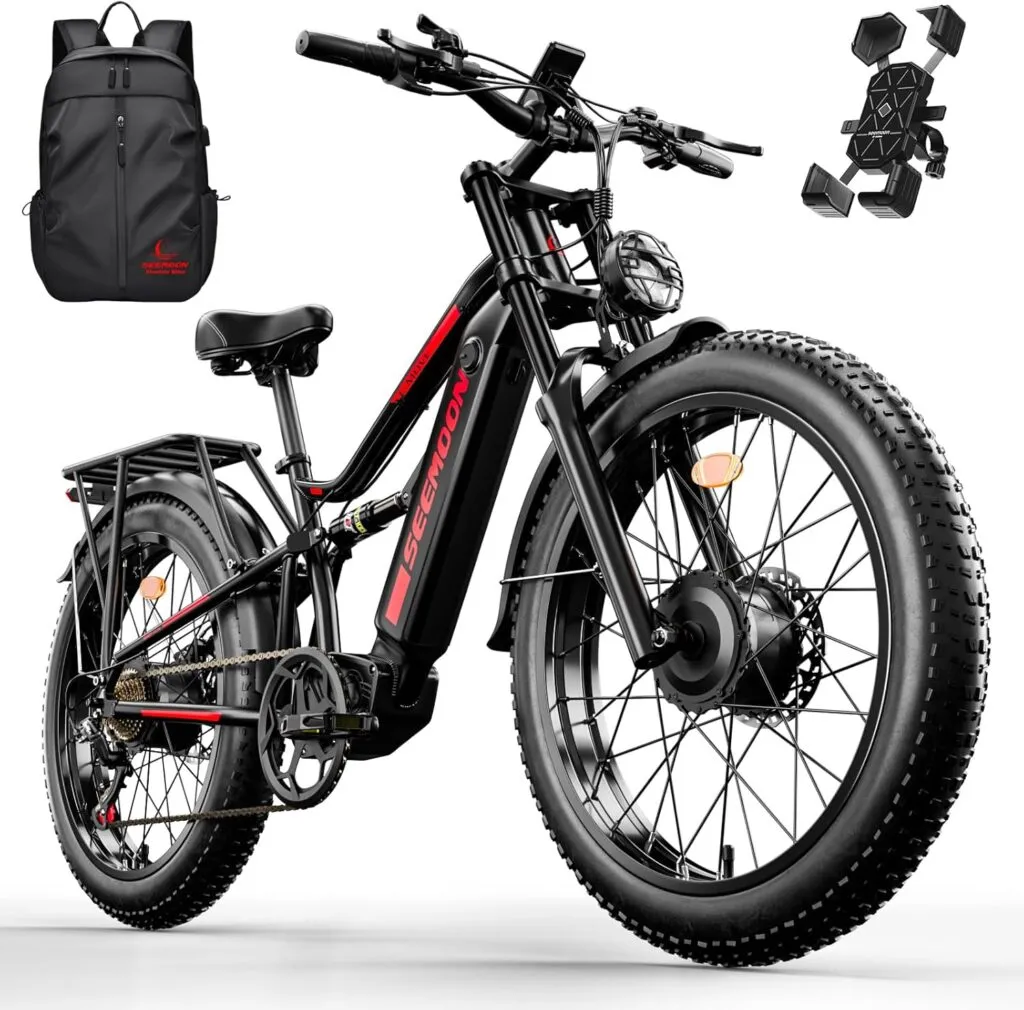
11. Best Suspension Setup: Seemoon Dual Motor 3000W Off-Road E-Bike
Key Details:
- Dual motors, 3000W peak output
- 52V 20Ah removable battery
- 26×4.0 fat tires, 7-level suspension system
- Top speed: 32–36 mph
The Seemoon off-road e-bike is all about control and comfort. During our testing, the 7-part suspension system really made a difference on rocky trails.
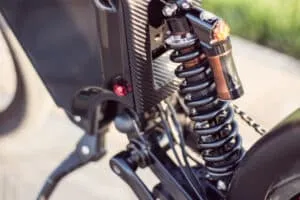
Between the front forks, rear shock, fat tires, and saddle springs, it smoothed out terrain that would normally be punishing.
Power-wise, it’s plenty strong. With both motors engaged, it climbed steep grades without complaint.
The 52V battery provided enough juice for 50–70 miles of mixed riding in our experience. The hydraulic brakes added confidence when coming down steep dirt descents.
It is a big machine, though, and it takes some muscle to maneuver at low speeds. Riders who want a lighter, more agile trail bike might find it too much.
But if you want a comfortable, powerful ride across dirt, snow, or gravel, this is a solid pick.
Pros:
- Excellent suspension for rough terrain
- Dual motors with solid hill-climb power
- Strong hydraulic brakes
- Good range for an off road e-bike
Cons:
- Heavier than many similar models
- Less nimble in tight spaces
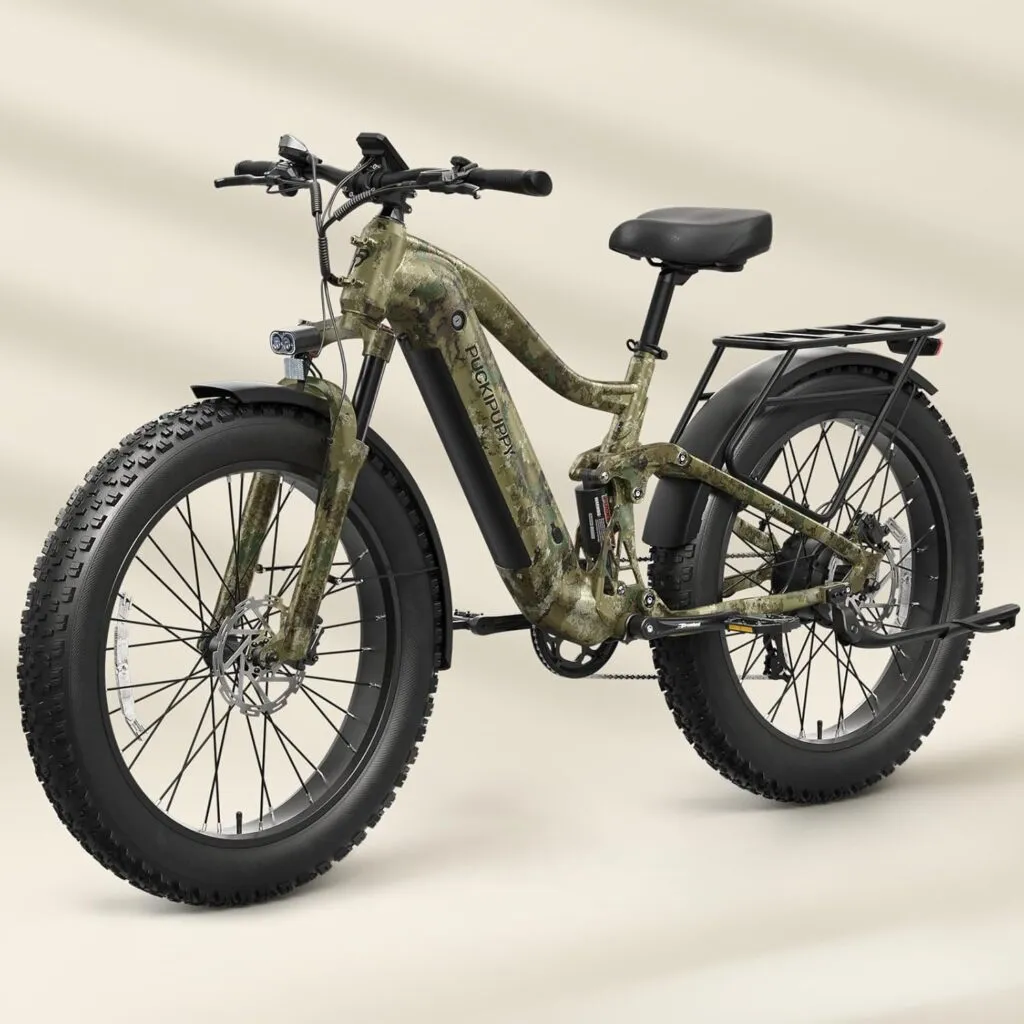
12. Best Flagship Design: PUCKIPUPPY Boxer Off-Road Electric Bike
Key Details:
- 960W peak motor, 48V 20Ah battery
- 26×4.0 puncture-proof fat tires
- Longitudinal hidden suspension design
- Top speed: 28 mph, 40–80 mile range
The PUCKIPUPPY Boxer stands out because of its suspension design. Instead of a standard setup, it uses a longitudinal hidden system that felt smoother and more stable when we tested it.
On gravel and forest trails, it absorbed bumps in a way that reminded us of a dirt motorcycle.
We also liked the accessories that come standard: rack, fenders, phone holder, mirrors, and more. It’s clearly designed as a flagship bike, with everything included to make it trail-ready out of the box.
The 20Ah battery gave us a reliable range of 50–60 miles in pedal assist, with more possible on easier terrain.
The downside is that its motor isn’t as powerful as others in this lineup. At 960W peak, it tops out at 28 mph, which may disappoint thrill-seekers looking for a high-speed off-road e-bike.
But for balance, comfort, and design innovation, it’s one of the more polished choices.
Pros:
- Unique longitudinal suspension system
- Comes with full accessory package
- Stable, comfortable off road ride
- 40–80 mile range in PAS mode
Cons:
- Lower power compared to dual-motor rivals
- Longer charge time at 8–9 hours
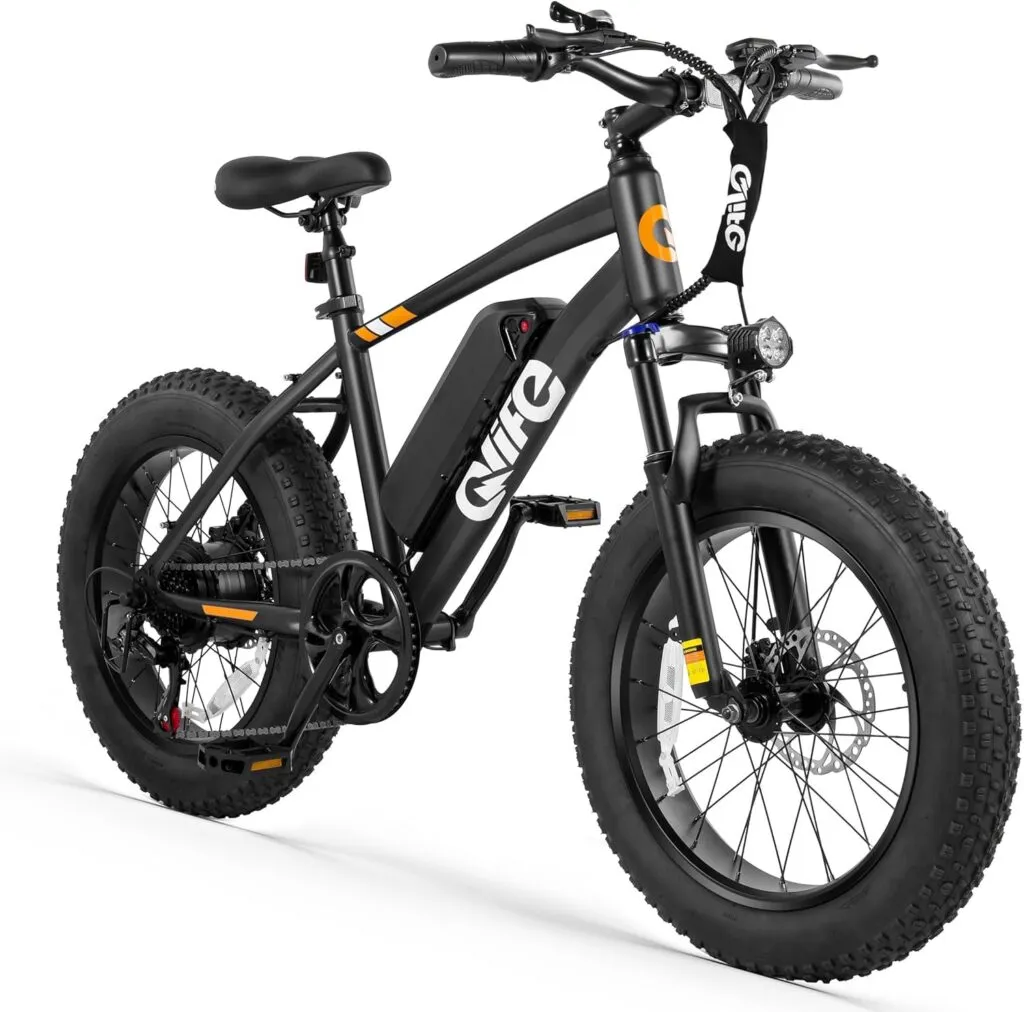
13. Best Lightweight Budget Option: Qlife Racer Off-Road E-Bike
Key Details:
- 1200W peak motor, 48V 10.4Ah battery
- 20×4.0 fat tires with front suspension
- Top speed: 28 mph
- Range: 40 miles throttle / 55 miles PAS
The Qlife Racer is a great entry-level off-road e-bike for riders who want something light and affordable.
When we tested it, we appreciated how quick and nimble it felt compared to heavier fat-tire bikes. The 20-inch wheels and smaller frame made it easy to store and transport, too.
Performance is solid for the price. The 1200W motor handled light trails and short commutes without issue, and the 10.4Ah battery lasted close to its rated 40–55 miles, depending on how much throttle we used.
The LCD screen was simple but gave all the info we needed.
The trade-offs are expected in this budget tier. The battery is smaller than higher-end off-road electric bikes, and you’ll need to recharge more often if you ride daily.
The single front suspension isn’t as cushioned as full-suspension setups either. Still, for riders on a budget, it’s a fun way to explore dirt paths and city streets.
Pros:
- Affordable entry-level off-road e-bike
- Lightweight and easy to handle
- 28 mph top speed is quick for its class
- Good range for a smaller battery
Cons:
- Limited suspension system
- Smaller battery requires frequent charging
Regular E-Bike vs. Off-Road E-Bike: Key Differences
A regular e-bike is designed for city streets and paved paths, while an off-road e-bike is built for trails, dirt, gravel, and uneven terrain. Off-road models usually have more powerful motors, bigger batteries, fat tires, and advanced suspension systems to handle rough conditions.
| Feature | Regular E-Bike | Off-Road E-Bike |
|---|---|---|
| Motor Power | 250–750W | 1000–5000W (often dual motors) |
| Tires | Narrow, city-friendly | Fat tires (3–4 inches) for grip |
| Suspension | Front fork or none | Full suspension with stronger shocks |
| Use Case | Commuting, city riding | Trails, dirt, snow, and steep climbs |
How to Choose the Best Off-Road Electric Bike
Finding the right off-road e-bike depends on how and where you plan to ride. Here are the main factors that matter most:
Motor Power and Torque
Off-road electric bikes need strong motors for steep climbs and uneven terrain. Look for at least 1000W, though many top models use dual motors with 3000–5000W peak output.
Torque is just as important; it’s what gives you pulling power uphill and through mud.
Battery Size and Range
Bigger batteries mean more miles on the trail. A 20Ah battery is usually the starting point for off-road use, while 25–34Ah packs can stretch to 70–100 miles in pedal assist.
If you ride throttle-heavy, expect real-world range to be shorter than the listed maximum.
Suspension Setup
Full suspension can make rough trails much more comfortable. In one controlled off-road study, peak vibration beneath the saddle dropped from 4.78 Hz with front suspension to 2.27 Hz with dual suspension, without a significant change in climbing speed or energy use.
For rocky trails, roots, and repeated bumps, look for full suspension with adjustable or hydraulic forks.
Tires and Traction
Fat tires around 3 to 4 inches wide give off-road e-bikes more grip and stability on sand, snow, gravel, and loose dirt. Wheel size matters too, but bigger does not always mean faster.
A 2026 study of 49 highly trained mountain bikers found no significant uphill or downhill time advantage for 29-inch wheels over 26-inch wheels on short, rocky terrain. In practice, choose based more on handling, comfort, and terrain than wheel size alone.
Braking System
Powerful motors require powerful brakes. Hydraulic disc brakes are the gold standard because they deliver reliable stopping power even on steep or wet terrain.
Mechanical discs can work but may struggle with heavier dual-motor bikes.
Weight and Portability
Off road e-bikes are heavy, often 80–120 lbs. Consider where you’ll store the bike and whether you need to load it into a vehicle.
Some riders value portability, while others don’t mind the extra weight in exchange for stability.
Final Words
The best off-road electric bike is not automatically the one with the biggest motor. Power matters, but suspension, braking, traction, battery capacity, and how controllable that power feels matter just as much once the pavement ends.
The PUCKIPUPPY Labrador Pro is our best overall pick. Its 1350W peak motor, torque-sensing assist, 48V 20Ah battery, fat tires, hydraulic brakes, and full-suspension setup make it a well-rounded choice for trails, gravel, hills, and longer mixed-terrain rides.
If raw power is the priority, the EcoE 5000W Dual Motor E-Bike is the more aggressive option. Its dual motors and huge 60V 32Ah battery make more sense for experienced riders who have suitable off-road terrain and want performance well beyond a conventional e-bike.
FAQs
What is the top speed of most off-road electric bikes?
Most off-road e-bikes reach 28–35 mph, though dual-motor models can push past 45 mph. Real-world speed depends on rider weight, terrain, and whether the bike is unlocked.
Are off-road e-bikes street legal?
It depends on local laws. Many regions limit e-bikes to 20–28 mph on public roads or trails. High-powered bikes above those limits may only be legal on private property or designated off-road areas.
Can you ride fat tire e-bikes in snow and sand?
Yes, that’s one of their strengths. Fat tires provide extra surface area and grip, making it easier to stay stable in loose or slippery conditions like snow, sand, or mud.
How long do off-road e-bike batteries last?
A typical battery lasts 30–80 miles per charge, depending on size and riding style. Over the long term, most lithium batteries can handle 800–1000 full charge cycles before showing reduced capacity.
What safety gear should you use for off-road riding?
Always wear a helmet designed for high-speed riding, and consider goggles, gloves, and padded clothing. For extreme terrain, many riders use full-face helmets and body armor similar to motocross gear.

Michael Josh is a hands-on e-bike tester and reviewer at BoltBikers, known for putting every model through real-world rides before sharing his thoughts. With a sharp eye for performance, comfort, and build quality, he helps the team choose which bikes are worth featuring. Backed by years of experience in tech and gear reviews, Michael brings trusted, honest insights to help readers find the right e-bike for their needs.